Creativity OS
The Creative Operating System for Musicians & Makers
Cohort Begins in October. Limited Seats Available.
THE COHORT IN ONE LINE
From Here to There.
Your Creative Self Now
A calendar that's completely full and a creative life that's empty
Momentum that starts and dies, over and over
A quiet suspicion that the part of your life where you made new things is behind you
Your Creative Self in December
One project finished and out in the world
A week that begins with creative work
A dependable system to minimize administrative bloat
A supportive group of co-conspirators
The proof isn't a plan. It's the thing you shipped.
WHAT WE WILL INSTALL
The Admin Staff You’ve Never Had
For decades, the support that made ambitious creative work possible lived inside institutions.
Orchestras had librarians and operations people. Universities had departments and administrators. Labels had producers and publicists.
If you were inside one, you got a staff. You walked in and you were exclusively creative, because someone outside your door was handling everything else.
If you were outside, you did all of it yourself. At night. Badly. And the art suffered because of it.
I know that trade well. I didn't wait for an institution to hand me a staff, so I built one. Nief-Norf was twenty years of being my own operations department so the work could exist at all.
What changed is that the tools have finally begun to catch up.
A capture system that works at 2am and in the car, so nothing is lost. Idea banks that hand a note back to you at the moment it's actually useful, instead of burying it in a list you never open again. Focus modes that decide what's allowed to reach you while you're working. Automations that run the same twelve steps every time without you touching them. A calendar that can actually hold a designed week. And sitting on top of all of it, an AI assistant that reads your calendar, sorts your files, drafts your budget, and hands you tomorrow's first action.
Between the tech stack and AI, the jobs that used to require a staff of four now fit on one person's desk. That is the whole reason this program can exist, and it's why it couldn't have five years ago.
So this isn't really about getting organized. Every piece of the system is a role an institution would have staffed for you, and now you can fill it.
You thought of it before you finished reading that sentence.
It's the one you mention when someone asks what you're working on, in the slightly embarrassed way, because you've been saying the same thing for three years.
None of this arrives as a decision. It settles in somewhere after the degrees are finished, and the job is real, and the calendar fills with other people's priorities.
You're great, and you've been great for a long time, and somewhere along the way the part of your life where you built something new…started to feel like it was harder to find.
Perhaps some of these sentiments feel familiar:
“I have a folder full of things at sixty percent completion."
"I've wanted to make this for years. I still haven't started."
"My calendar is completely full and my creative life is empty."
"I keep waiting to be asked. Nobody's asking."
"I watch people with half my ability put work out, and mine sits."
"Every time I get momentum, the day job eats it."
"I've made the plan four times. It never survives past week three."
In short, the work you care about most is the work that rarely gets done.
WHAT YOU WILL BUILD
You Already Know Which Project It Is
The Path We Were Trained for is Narrowing
Most of us were taught one route. Win the audition, take the seat, wait to be hired, and let an institution carry the career. That route built real lives for a long time and it still does for some people.
It's also getting thinner. There are fewer stable chairs, fewer commissions routed through fewer gatekeepers, and a degree that still doesn't teach anyone how to build a career rather than fill a vacancy.
Meanwhile something else got easier. The tools to plan, produce, fund, and release ambitious work are within reach of any individual now. Audiences follow artists rather than institutions. A self-initiated project can find its people without anyone's permission.
THE LANDSCAPE
Avoid Common Stalls
HOW THE CHANGE ACTUALLY HAPPENS
01
Too Many Priorities
Week 1
Nothing gets finished when six things are half-alive at once. Attention divides, and a project running on a third of your focus never builds the momentum it needs to survive a hard week.
One project gets chosen out loud, in front of supportive witnesses. Everything else goes on a named shelf with a date to revisit, which is a different thing from a graveyard because it's deliberate. Putting five things down on purpose is the first relief people report.
02
Define
Done
Week 2
A project without a finish line can only be abandoned, never completed. "Record an album" has no edge. It expands to fill every hour available and still isn't done, which is exactly why it's been sitting for four years.
We scope it until a stranger could look at it and say whether it's finished. Format, length, constraints, and a real date. Most people cut their project roughly in half here, and that cut is what makes it possible.
03
No Time
Each Week
Week 3
Your creative work is the only thing on the calendar with no external deadline, which makes it the first thing to move when the week gets loud. That's a design problem, and design problems have designs as solutions.
We back-plan from your ship date into dated milestones, then build your week around the biggest rock so the work has a home before the week starts. Every block gets a first action, because a block that says "work on the album" gets skipped and one that says "open the session, loop the B section" gets started.
04
Witness Protection
All Weeks
This is the real one, and it's why reading about any of this has never been enough. You already know most of what's above. What you haven't had is someone who notices when a week goes by.
Multiple support networks, stacked. A weekly scoreboard where you say what moved in front of the same cohort of peers. Live coaching in front of the room, and two private sessions with me at the two moments projects usually die: when the plan is set, and when the finish is in sight.
The first three are things a smart person can do alone. The fourth is the one you can only get from a room, and it decides whether the other three hold.
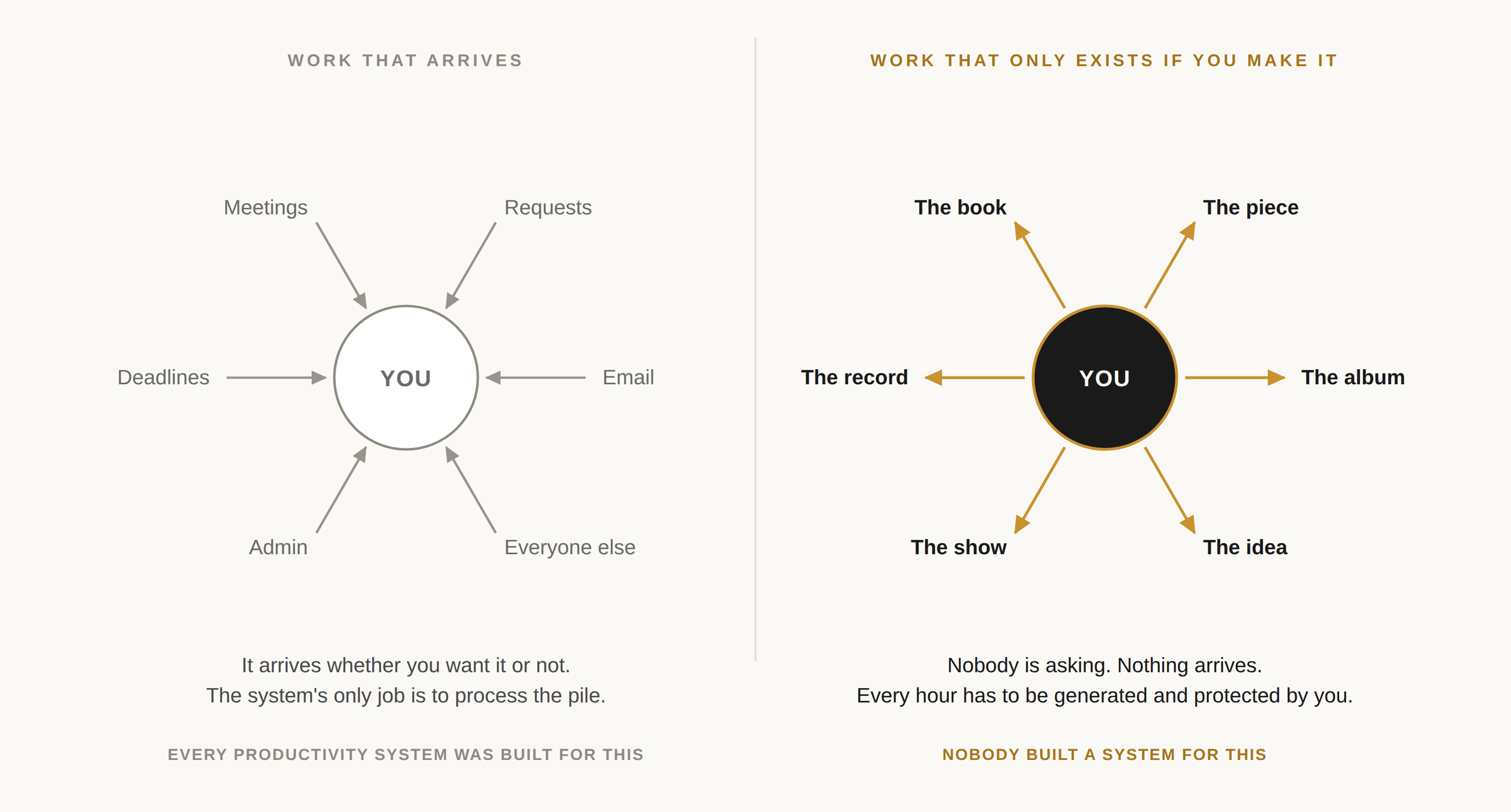
Two Kinds of Work. Only One has a System.
INTRODUCING
CreativityOS
A ten-week cohort for people who are done waiting for the right season to start.
You bring one project. The one that's been sitting there.
Over ten weeks we build the system that moves it, and we move it.
You choose it in week one, in front of a group of peers for accountability. You scope it until it has an edge and a date. You back-plan the runway, design the week it lives in, and build the capture and review habits that keep it alive when October gets loud.
Then we make it, cut what needs cutting, fund it, finish it, and put it out.
An institution would have hired four people to do what you're doing alone.
A manager to hold the budget and the calendar. A marketer to keep people watching. An agent to go get the work. And an artist to actually make the thing.
You are all four.
The ten weeks is built around those four hats, and by December you're wearing them on purpose instead of by accident.
The Curriculum
-
Before session one we install the two tools everything else runs on. Obsidian becomes your studio: where the projects, notes, plans, and ideas live. Claude gets set up with an instruction file so it actually knows who you are and what you're working on. We do it live with screens shared, and you inventory everything sitting on your shelf. You don't need to arrive knowing anything about either tool.
-
Twelve-week years instead of annual goals, because a year is too far away to steer by. Setting one to three goals across a whole life rather than only across work. Then choosing the one project that carries the quarter, out loud, in front of eleven people, and putting everything else on a shelf with a date to revisit. You leave with a twelve-week year and a project named.
-
Defining done so precisely a stranger could verify it. Sorting the ambitious from the aspirational, which is a question about resources rather than nerve. Then time debt: pricing the project in real hours per week, including the recurring maintenance everyone forgets, and naming what it displaces. Most people cut their project in half here, and that cut is what makes it possible. You leave with a scope, a ship date, and an honest hour count.
-
The two things you actually own: a mailing list and a website. Why an owned audience beats a rented platform for work that matters. Story first, and what's worth sharing while the work is still ugly. This is where the weekly note starts, so that by December there are people who watched the thing get made instead of an announcement into silence.
-
Back-planning from the ship date into dated milestones rather than forward from today. Working from openings instead of deadlines: a deadline is when you lose the option, an opening is when you have the best selection. Halls, players, collaborators, grant pools, and release windows are all scarce and first-come. You leave with a milestone chain and a list of things to book this month.
-
Building the week around the biggest rock instead of hoping it fits in the gaps. Theme days, peak hours held like a paid gig, place, and focus modes. And the first-action rule: "work on the album" is where momentum dies, "open the session, loop the B section" is where it starts. You leave with a week your project actually lives in.
-
How the work actually gets made. A reusable working session instead of rebuilding your setup every time. Drafting ugly and iterating, density over polish, and how to start on a day you don't feel like starting. We work in front of each other, which is what makes the ugly middle stop being frightening.
-
Where every project really is, against the plan from session four, in front of the room. Cutting scope as a skill rather than a failure, because cutting in November is what lets a project ship in December. We repair whatever part of the system isn't holding, and we ask the honest question: is the date still real?
-
Pricing what you do. Building a real project budget line by line, including the lines everyone forgets. The four paths that pay for creative work: commissions, grants, sponsorship, and your own offers. And drafting the grant narrative, which is where most people stall for months on a blank page.
-
The last twenty percent, which is a different skill from the first eighty. Feedback that improves the work instead of stalling it. How to call something done. Then the real share, to the audience you've been building since October, with the room pushing together.
-
Running an actual quarterly review: scoring the goals you set in session one, honestly. The full cadence you've been living — daily, weekly, monthly, quarterly — and which parts are load-bearing. Then setting the next twelve-week year while the momentum is still warm, with the next project already scoped. No session November 26. Enjoy Thanksgiving
Everything Happens in One Place
The whole cohort runs inside Creative Pulse Labs, my community on Circle. One login, one place, everything in it.
The live sessions happen there.
Every recording lands there, yours to keep.
The templates and the prompt pack sit there ready to copy into your own vault.
The daily check-in thread is there between sessions.
Your thinking partners are there.
The entire cohort is there.
Most cohorts scatter across five tools. A Zoom link buried in your inbox, recordings in a Dropbox someone has to remember to update, worksheets in a Drive folder, conversation in a group chat, and a calendar invite you accepted in September. Every one of those tools is good at its own job.
What none of them do is hold a ten-week experience together well enough that you can still find it in 2028.
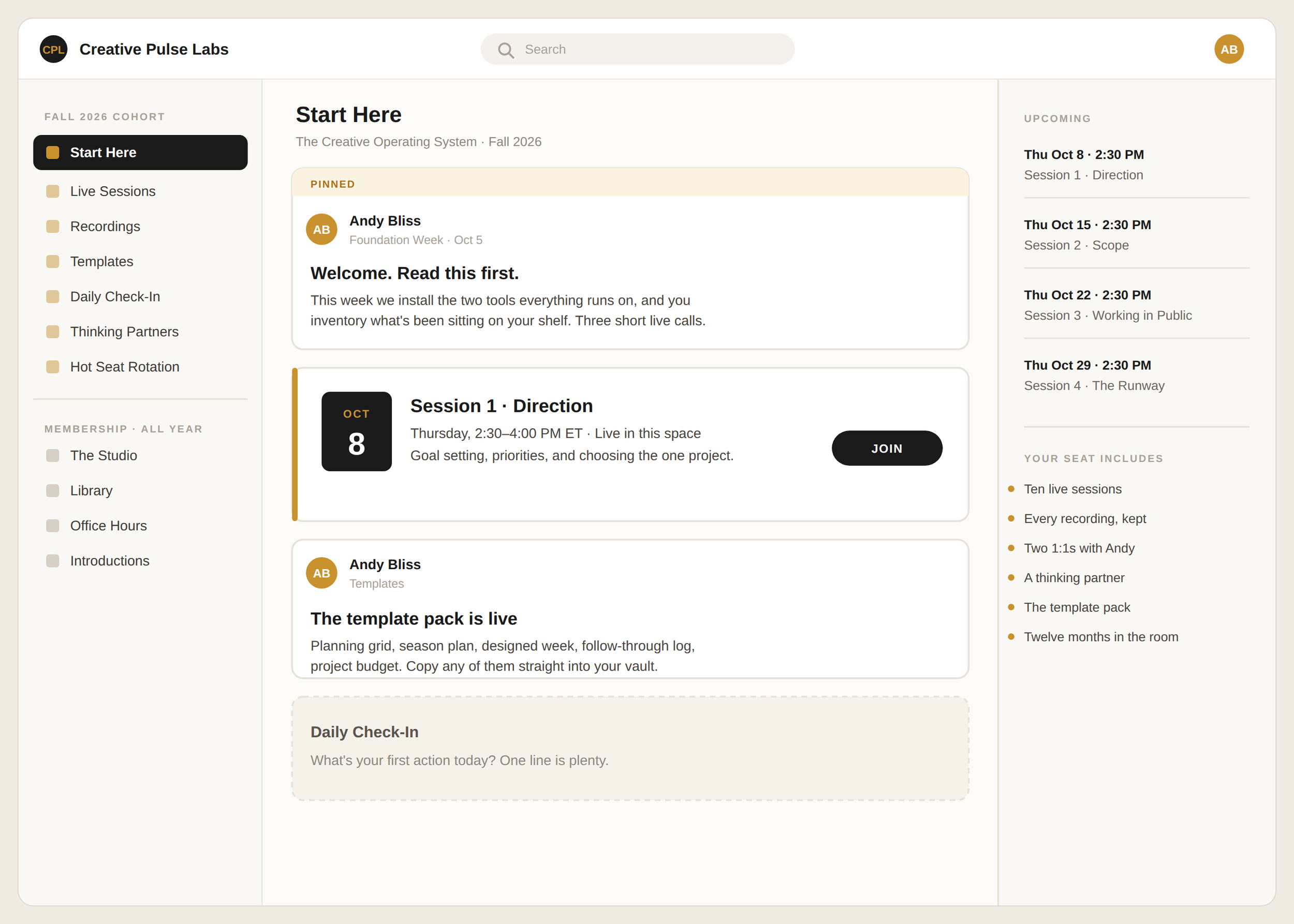
The work happens between sessions Thursday to Thursday.
This is the part people underestimate. Ninety minutes a week is the spine, but it isn't where most of the progress lives.
The progress lives in the six days between: the block you protected, the scope you cut at 11pm, the question you couldn't ask until Tuesday.
That's what the community is for. You post the day's first action in the check-in thread. You ask the room a question when you're stuck and get an answer before the next session. You watch your colleagues work on their projects, which turns out to be the most useful thing on offer, because most obstacles rhyme and somebody else has already hit yours.
That's the difference between a course and a room. A course ends when the last video does. A room is still there when you need it again.
And no new tool to learn, by the way. Circle is a website. You log in and you’re done.
System Requirements
Weekly Training Coursework
Training Videos, templates, and documents
(10) Live Group Coaching Sessions
Thursdays, 2:30 to 4:00 PM Eastern, October 8 through December 17.
Ninety minutes each.
No session on November 26.
Every one is recorded and yours to keep.
(10) Joint Co-working Sessions
Weekly build time in your week - the first large rock placed strategically.
Accountability for investing time into your craft.
(2) 1:1 Private Coachings
60 minutes of uninterrupted work on your project
24/7 Circle Community Access
Weekly Topic Discussion Board
Monday Intention Threads
Friday Wins Club
Your Host
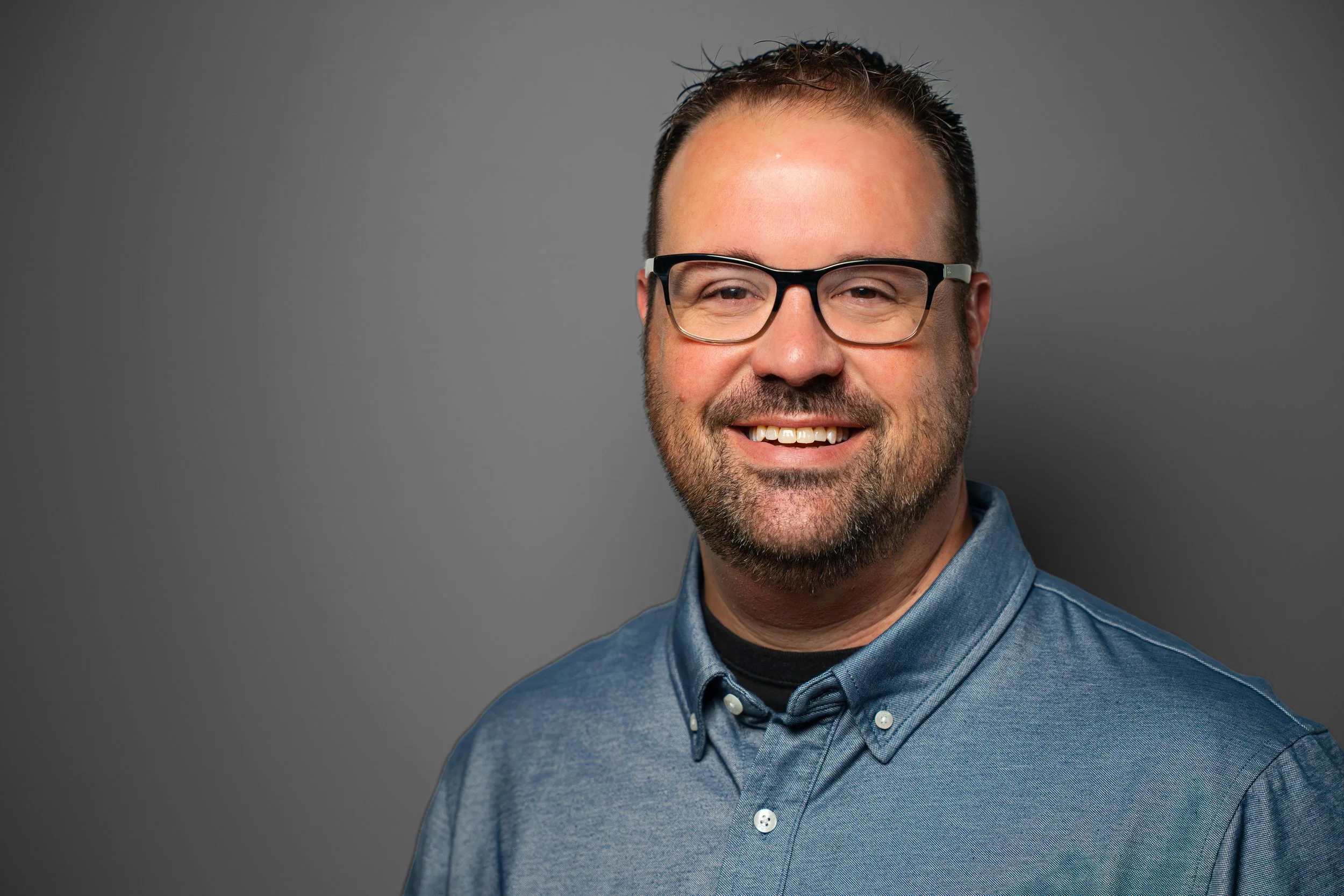
Andy Bliss
Percussionist I Teaching Artist I Creative Entrepreneur
For more than twenty years, I've built a career in music as a performer, educator, producer, and artistic director. Along the way, I've had the privilege of leading nationally recognized arts organizations, performing contemporary music around the world, and helping hundreds of musicians discover their own artistic voice.
From the outside, it looked like a successful creative career.
But behind the scenes, I often found myself asking the same questions so many artists do:
How do I make time for the work that matters most?
How do I build a career that supports my creativity instead of competing with it?
And how do I create a life that's both artistically fulfilling and financially sustainable?
Those questions led me to rethink everything.
Over the past several years, I've been intentionally designing a creative life where performance, teaching, entrepreneurship, digital products, and personal artistic projects all work together as part of a single, meaningful vision.
That's what I've spent the last several years building, and it's what I teach now.
CreativityOS is that system, handed over. Not the theory of it. The actual grid, the actual week, the actual review loop, the actual assistant setup, running on your project instead of mine.
I'd love to help you build yours.
CREATIVITYOS IS A SMALL, HIGH-TOUCH COHORT FOR WORKING ARTISTS.
For artists who are done waiting to be chosen.
An institution would have staffed four people to do what you're doing alone — someone holding the calendar, someone keeping an audience watching, someone going after the work, and someone actually making it. A part-time assistant covering only the first of those runs $30,000 to $50,000 a year, and (if we're being honest) most working artists never get one, and never will.
CreativityOS delivers the operating system built for the exact problem you have: work that nobody is asking for, that only exists if you generate and protect every hour of it yourself. It's custom-fitted to entrepreneurial, multi-faceted artists who want to build what's theirs instead of waiting for permission.
No theory, no busywork, no assignments that aren't your own work. We work inside the reality of your career, on the project you brought, using your ship date as the guiding light. Three months — not a year — because it's short enough to see the finish from the first week and long enough that something real gets made inside it.
You'll gain a working system you keep for good, and experience the identity shift that comes with using it: from someone who starts things to someone who finishes them. That one carries forward into everything you make next.
FULL PROGRAM – OCT TO DEC
$2,500
Payment Plans of $895 for 3 Months Available
Ten live coaching sessions — Thursdays, 2:30–4:00 PM ET, recorded and yours to keep
Ten co-working sessions — protected build time, already on your calendar
Two private 60-minute sessions with Andy
Foundation week — Obsidian and Claude installed live, screens shared
The template pack — planning grid, season plan, designed week, follow-through log, project budget
Your cohort space in Creative Pulse Labs — sessions, recordings, and the daily thread in one place
Begins October 2026. Spots are Limited.

ENROLL TO JOIN THE PRE-PROGRAM BEFORE SEP 15
Join Early.
Get More.
ENROLL BY SEPTEMBER 15
Start in September, not October.
A Third private session. Two sixty-minute sessions come with every seat — enroll by September 15 and you get a third, placed wherever you actually need it.
A Full Year of membership in Creative Pulse Labs Circle community. This means in December, you stay in the Labs through the summer of 2027 for free. The Labs includes a monthly Ask Me Anything session, bi-quarterly planning sessions, bi-quarterly book clubs, and 24/7 Discussion Boards on all things music and creativity.
Is this you?
This is for you if…
You can name the project – or a few of them – right now. You thought of them in the first thirty seconds of reading this page.
You've been out of school long enough for your days and weeks to fill up and haven’t had time to re-install a new OS.
You're willing to be seen mid-process — including the week you didn't touch it.
You're done waiting and ready to take action!
This isn't for you if:
You're still in a degree program. Come to the free workshops instead; this lands differently once a career has been happening to you for a while.
You want a course to watch on your own time without taking action.
You want the system without the project. The project is what proves the system works, and week one requires one.
Frequently Asked Questions
-
That feeling is the exact thing we're working on.
This isn't more to do, it's a redesign of where your hours already go. And it likely won’t get better if we don’t start.Think of it like revisiting that flower bed you haven’t touched all summer. You know the one…
-
Those attempts taught you something real about what you'll actually maintain, and that's useful to bring in.
What's different here is that you aren't maintaining it alone. A room, live coaching, and digital community are what carry a system through the week it would otherwise get dropped.
-
Every session is recorded and yours to keep.
You'll get more out of being live and most people make most of them, but one travel week won't cost you the thread.
You can also pre-share. a coaching request and we will address it asynchronously as best as we can.
-
Anything with a finish line. An album, a piece, a book, a course, a recital program, a residency application, a website. If you can define done, we can ship it.
-
Not at all. Foundation week exists for exactly this, and we do it live with screens shared. Obsidian is free and Claude runs about twenty dollars a month.
-
Ninety minutes live, the co-working sessions, and the block you're already protecting for your project.
It's a redesign of your hours more than an addition to them.