Make the next 12 weeks count
A live planning session for musicians and makers. Tuesday, September 29, 12:30–1:45 ET. Score Q3, pick one to three things for the fall, and price them against the hours you really have. Free.
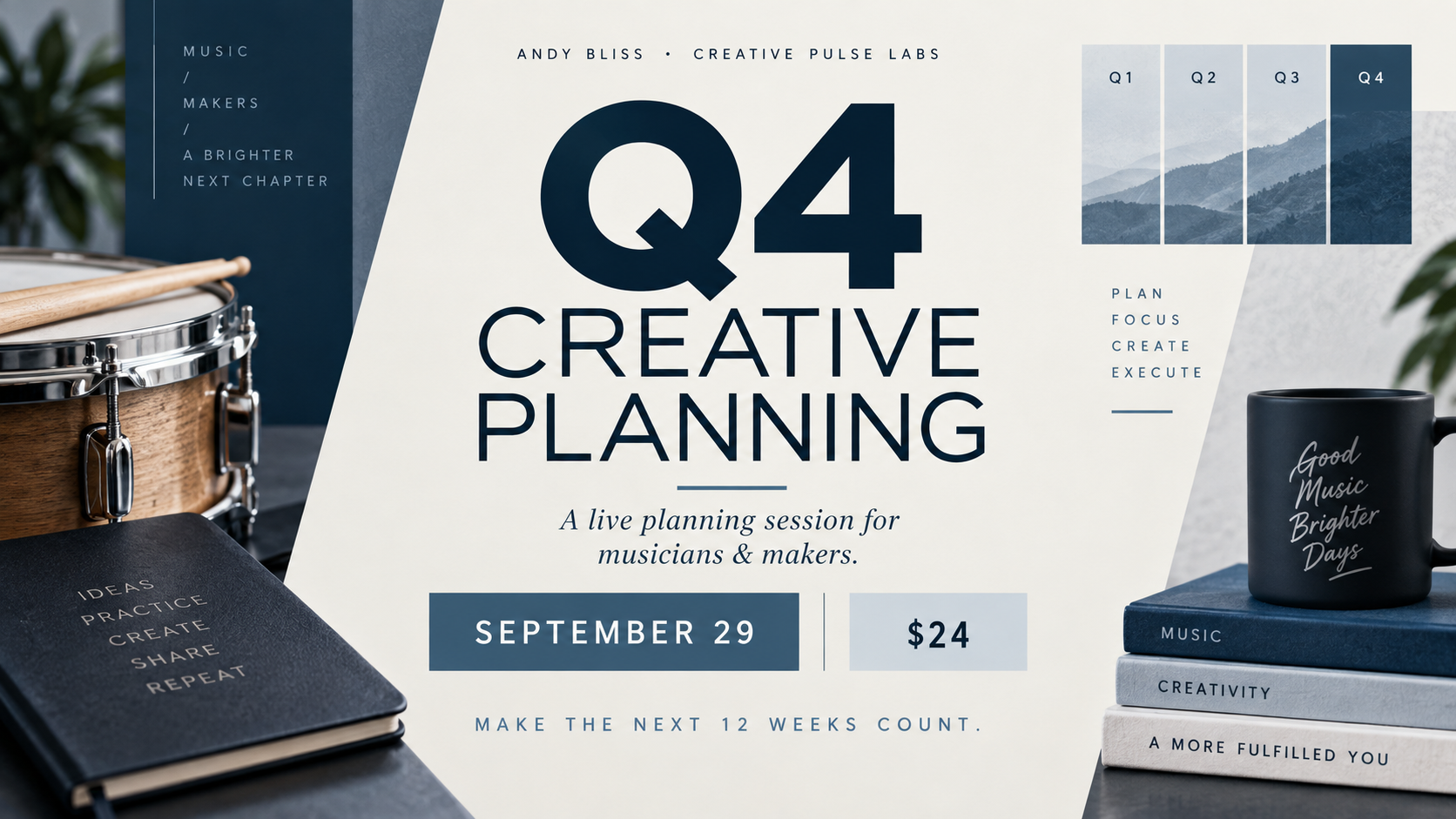
Q4 Creative Planning — a live planning session for musicians and makers. Tuesday, September 29. Free.
October 1 is two weeks out.
On Tuesday, September 29, I'm running a live planning session for musicians and makers. 12:30 to 1:45 Eastern, online, inside Creative Pulse Labs.
We do three things. Score what actually got made in Q3. Pick one to three things worth doing between October and December. Price them against the hours you really have.
Bring your calendar. You'll leave with a Q4 map and the first few weeks already blocked.
Free to attend. You'll need a Creative Pulse Labs account, which is also free.
If you can't make it live, the recording goes up in Labs for everyone who registers.
What I Sent My Nephew
He’s starting percussion. The photo I sent him was mostly a rubber pad, and that was the point.
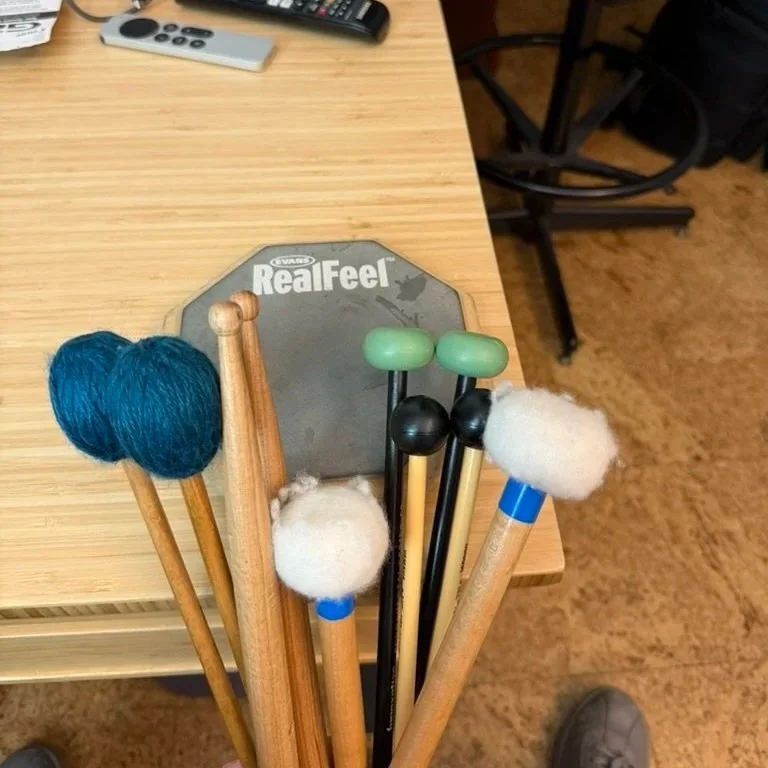
A practice pad and percussion mallets — yarn, rubber, hard plastic — with a pair of drumsticks.
My nephew is starting percussion!
Rounded up a bundle of things from the depth of my gear cage: a practice pad, a fistful of mallets, and of course some sticks.
Really excited for him to start this journey. Hope it brings him a fraction of the joy that it has brought me in my lifetime.
Perhaps I should have also included some knitting needles, a chopstick, maybe a comb?
The Steel Pan Detour
I have played bass pan at Panorama in Brooklyn and at the World Steel Band Festival in Port of Spain. Neither is on any track toward the job I have.
Years ago, I had the pleasure of playing double seconds at Brooklyn Panorama — the largest steelband celebration in the world outside Trinidad and Tobago itself. I was privelaged to join Crossfire Steel Orchestra’s performance of Scene, arranged by Kendall Williams, made up of players from Trinidad and Tobago, the wider West Indies, and all over the United States.
Before that, in 2000, I played bass pan with Northern Illinois University’s steelband at the World Steel Band Festival in Port of Spain. We placed second. It was the first U.S. group to place in the finals of that competition.
Relatively speaking, very few people I know in music have walked these musical roads. It doesn’t appear in the “standard” literature, and it will not help you win an orchestral audition. In fact, many percussion programs are severely lacking in exposure to non-Western styles comprehensively.
A steelband arrangement for Panorama is eight to ten minutes of continuous music, memorized, played by somewhere between sixty and a hundred people, most of whom are reading nothing at all. There is no conductor keeping you honest. The arrangement lives in the room, distributed across everyone, and it stays alive only because each section knows its part cold and knows where every other section is at all times.
That is a completely different model of ensemble from the one I was trained in. In the music I usually play, precision comes from the page and from a person out front holding it together. In a steelband it comes from everyone having internalized so much that the thing is load-bearing without either.
I think about it constantly when I work with a percussion ensemble. The instinct is always to add structure: more rehearsal marks, more cues, more of me. The steelband answer is the opposite — put the information in the players until the structure isn’t needed.
Playing in the NIU and Crossfire Steel bands remains some of the single most useful ensemble experiences I have had, and ironically, it is the one nobody asks me about.
The Snare Drummer From Sevier County
Dolly Parton played snare in a marching band forty-five minutes from my office, then spent the rest of her life paying for other people’s.
In 2013 a high school band director named Nathan Hickman took his students to play a concert at Dollywood, and one of them asked whether he knew Dolly Parton.
He said yes. He said they’d been friends for years.
He had never met her.
She overheard it. And when she walked out on stage she said, “Hey Nathan! I’m so glad you are at Sevier County now!” and hugged him in front of his entire band.
He found out later this was a whole apparatus — somebody standing offstage feeding her the names of people she was about to meet. He says it’s still one of his favorite memories.
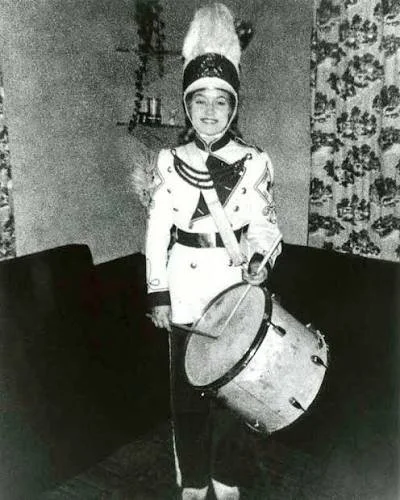
Dolly Parton, September 1963
I keep turning that over, because the machinery doesn’t cheapen it. It’s the opposite. Somebody built a system whose entire purpose was making other people feel known. That takes staff, and planning, and a decision about what your fame is for.
Sevier County High School is about forty-five minutes from my office. Dolly graduated in 1964 and left for Nashville the next day. Before she left, she played snare drum in the marching band.
She funded that program for decades afterward. The band wears small butterflies on their purple uniforms because of her. She was also an anonymous donor to hundreds of school districts across the South, most of them primarily Black, plus food banks and literacy programs she never put her name on.
She died on August 25th, at 80.
Tomorrow night the Sevier County band plays “I Will Always Love You” at halftime alongside the Jefferson County band, and the alumni are coming back to play it with them.
Here’s what I can’t get past, teaching percussion in the same corner of this state.
Snare drum is the least glamorous job in a marching band. You’re the timekeeper. No melody, no solo, and if you’re doing it perfectly nobody notices you at all. Every drum line I’ve taught has one kid who understands that the section works because somebody is willing to be the floor.
She was that kid. Then she got the biggest voice in American music and spent fifty years quietly being the floor under everybody else’s band program.
Hickman said it better than I can. He said she was a tiny giant.
Nobody Asked Us To Do Any Of It
Four of us rehearsed ten hours a week for nothing. It is still the most useful thing I have ever done.
There was a practice room in college with a shelves of drums and laminate floors and four of us in it, ten hours a week, for no credit.
Nobody assigned it. There was no jury at the end. We decided one day we were a quartet, and then behaved like one until it was true.
We built a website in 2001, thanks to one member having a 2nd degree in design. We made an album, thanks to a professor who had a side-gig in audio engineering. We got ourselves a showcase at our national convention pairing live chamber music with interactive video, which nobody was doing then and which we mostly figured out by getting it wrong until we got it right.
I’ve thought about that room more this fall than I expected to, mostly because the pattern has held.
Every single thing in my working life that turned into something — the festivals, the ensembles, the writings — started the same way. Not with an invitation. With a few people deciding to act as if the thing already existed.
Assigned work has a deadline and a grader and a clear finish. It is also, almost by definition, work somebody else already imagined. You can do it excellently and still land exactly where the assignment pointed.
Unassigned work is slower, and it feels indulgent for a long time. There’s no external signal telling you it’s going well. Ten hours a week is a lot to spend on something that might amount to nothing, and for most of that first year it did amount to nothing.
Then it compounded, all at once, in a way I could not have planned.
I’m not romanticizing being busy. The point isn’t volume. It’s that the hours went somewhere nobody was watching, which is the only place work becomes yours instead of a well-executed version of somebody else’s idea.
So the question I keep putting to my students, and lately to myself: what are you working on that nobody asked for?
If the answer is nothing, that’s worth knowing. It usually means the assigned work has quietly taken all of it.
I write a note each week diving deeper into ideas like these. It’s here if you want it.
A New percussionist on campus
Somebody built a balloon marching band member in the lobby, and of all the instruments in the building they handed him the punchline.
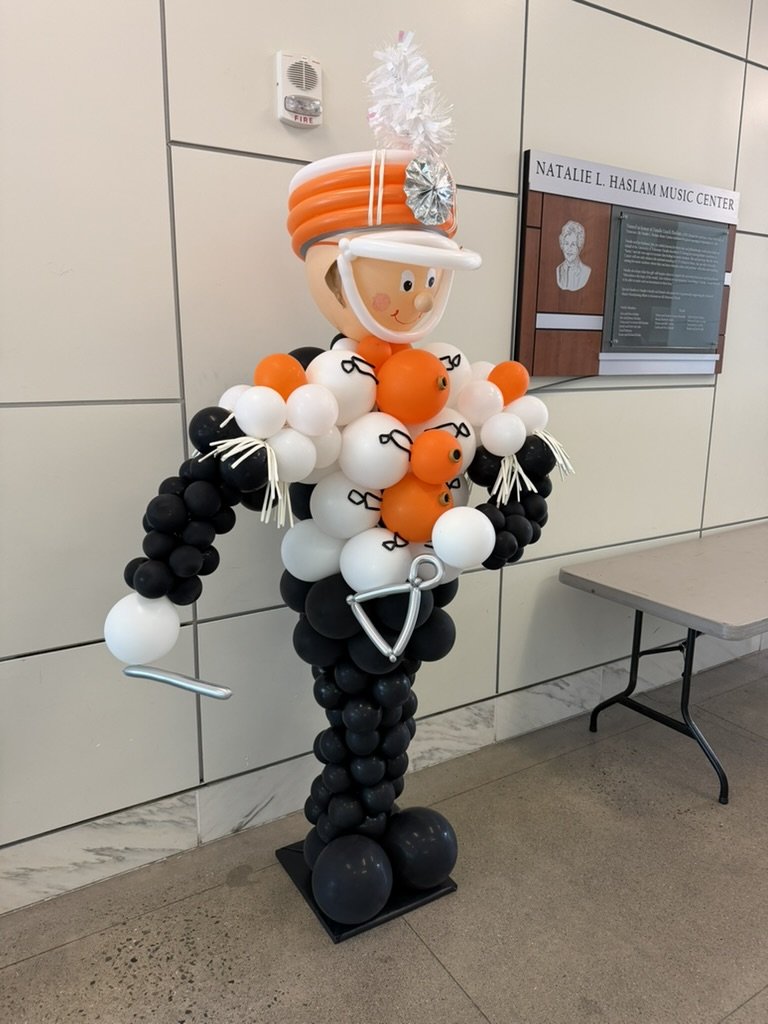
First week of classes, and somebody has built a balloon marching band member in the lobby of the Haslam Music Center. Orange and white shako, tinsel plume, rhinestone on the front, little squiggles down the uniform.
Also, they gave him a triangle. :)
Beater in one hand, triangle dangling from the other. Out of every instrument in that building — and there are a lot of them — the balloon guy got the triangle.
I’ll defend it a little. Not because the triangle is secretly the hardest thing in the orchestra, because it isn’t. But it is exposed in a way almost nothing else is. One note, no attack to hide behind, nowhere to blend. If you’re early, everybody knows exactly who was early. There’s no section to disappear into and no chord to be a third of.
Which is a real skill, and also, yes, it’s a triangle.
He’s holding it about right, though. Grip’s a little tense. We’ll work on it.
Welcome back to everyone here on Rocky Top. 🍊
The Uphill Battle
Percussion is the only section of the orchestra that had to argue its way in. That turns out to be useful.
There’s a joke that follows every percussionist. You’ve heard some version of it — the one about the knocking that speeds up, the one about what you call the guy who hangs around with musicians.
I’ve been hearing them for thirty years. I still laugh at the good ones.
But here’s what I’ve started noticing. Percussion is the only section of the orchestra that had to argue its way in. Strings were assumed. Winds were assumed. Drums had to make a case — piece by piece, composer by composer, across about two hundred years. Somebody had to convince a room full of people that a bass drum belonged there at all.
That’s a strange inheritance to carry.
Percussion is the only section of the orchestra that had to argue its way in.
It also turns out to be useful.
We had a guest artist in the studio this week, Dieter Hennings, sitting with our students and talking about the shape of a career. He said something I’ve been chewing on since: every musician needs a team.
Not a manager and a booking agent. Collaborators. The people who make the thing with you. Nobody is going to hand you the room, and you don’t build it alone either — you build it with a community.
Which is, historically speaking, the percussionist’s entire job description.
We’re the ones who show up to a piece with no performance tradition and work out what the instrument even is. We’re the ones who invent the setup because the setup isn’t written down. We convince the composer. We find the four other people who want to make the strange thing with us.
Nobody asks. That’s the whole point.
I spent twenty years building Nief-Norf, and not one day of it began with an invitation. It began with a phone call to somebody whose work I wanted to be near.
So here’s the small thing, if you’re carrying something nobody has asked you for.
Name one person who would make it better. Tell them about it this week.
Just the idea, said out loud, to somebody whose work you respect. That is how every real thing I have made got started — not with a plan, with a conversation.
The joke is that drummers just hit things.
The truth is we have spent two centuries learning how to argue for the thing we want to make, and then making it anyway.
Dolly
She got a song a child can sing back and a professional can study for a career out of the same three chords.
Dolly Parton died this week, at 80.
I live in Tennessee. You don’t get to be a musician in this state and not have some relationship to her, even if your own work sounds nothing like hers — and mine doesn’t.
What I’ve always taken from Dolly is economy. She wrote songs a child can sing back after one hearing and that a professional can study for a career, and those are usually two different skill sets. She got both out of the same three chords. That’s not simplicity. That’s someone who knew exactly what to leave out.
Most of what I do is the opposite — more information, not less. Which is probably why it lands so hard when somebody does it the other way.
Finish One Thing
Creative work isn’t finished when it’s good enough. It’s finished when you decide to share it.
I’m a starter.
I’ve got folders — okay, several folders — full of things I began with real fire and never quite finished. A piece that’s three-quarters composed. A course outline that stalled at week four. A recording that’s been “almost done” for longer than I’d care to admit.
Starting has never been my problem. Finishing is.
And I’ve come to believe that creative work isn’t finished when you start it, and it isn’t finished when it’s finally “good enough.” It’s finished when you decide to share it — when you cross the line from mine to yours. That’s the hard step.
Starting is safe. It’s exciting, and it never really risks anything. Finishing means deciding a thing is done, putting your name on it, and letting people see it — flaws and all. No wonder so many of us keep a graveyard of almost-finished projects.
But this week, a few things actually crossed that line. A performance video the ensemble and I had been sitting on finally went out. I wrapped a workshop I’d been building for weeks. And on Monday, courses that lived on my computer for months open up to students.
None of it is perfect. All of it is out.
Because creativity isn’t measured by how many things we start — it’s measured by how many we’re willing to finish. And a finished thing, flaws and all, gets to do what an unfinished one never can: teach someone, move someone, remind another maker they aren’t building alone.
So if you’ve got a graveyard like mine, don’t start something new this week. Go finish one thing you already began — and let it go do its job.
Under the Surface
Nobody claps for the outline. But that chaotic layer is exactly what everything beautiful ends up standing on.
My daughter Ellie just turned nine, and right now the two of us are elbow-deep in a new build — not a set from a box, but a MOC (LEGO-speak for “my own creation”): a custom diorama we’re putting together to show at an upcoming LEGO exhibition.
Here’s something most people don’t know about builds like this. We rarely start on a clean baseplate and go straight up. We build a hidden foundation first — a technique called MILS (Modular Integrated Landscaping System): you scatter small bricks across the baseplate in a set pattern, then cap them with a layer of plates. That plate layer becomes your new “ground,” the surface where the real build begins.
And here’s the part I love. The bricks down in that foundation are whatever we can dig up — mismatched colors, odd sizes, leftovers from a hundred old sets. Builders call it “filler brick.” Underneath, it’s a colorful disaster. Total chaos.
But every bit of the beauty — the careful color, the clean lines, the little glowing scenes — starts one plate higher. And none of it would stand for a second without that mess holding it up.
That’s about where I am right now. The beach is behind us, Ellie’s got a new number on the cake, swim season is winding down — and my calendar is quietly filling back in with classes, rehearsals, and a fall that’s coming fast.
For years I resisted this stretch. I’d wish for one more empty week, one more chance to “get caught up.” Now I’ve started to love it, because I finally understand what it actually is.
It’s the filler brick.
This week I’ve been outlining courses my students will step into in a few weeks, interviewing for next year’s studio leadership team, and sitting with a new composition that’s barely starting to find its voice. None of it is finished. A lot of it is messy, whatever-I-can-find groundwork that no one will ever see.
Beginnings rarely get applause. Nobody claps for the outline, the rough first draft, or the calendar you finally untangled. But that chaotic layer is exactly what everything beautiful ends up standing on.
So whatever you’re starting right now, don’t rush past the messy part. It isn’t the boring part, or the throwaway part. It’s the foundation — and the good stuff only rises because of it.
The Beautiful Game
The flashy touches get the applause. The part that actually works lives in the spacing and the timing.
I didn’t grow up with soccer. I’m finding it now, in my forties, and this summer it finally clicked.
Half of it was the company. We chased matches all over Knoxville — Orange Hat Brewing to watch Scotland bow out, the U.S.–Belgium game when we struck out at four different spots before ending up in a friend’s living room with thirty other people, a night at Printshop Beer Co. in South Knox watching Spain beat that same Belgium side. Somewhere in there I stopped being a curious bystander and started loving the game.
Then I watched Spain grind out a 2–0 win over a tough France team. Spain’s second goal looked almost boring on paper — a simple give-and-go, a pass and a run into the space that opened up. No trickery. Just two players who trusted the timing.
I watched it back three times.
They call soccer “the beautiful game,” and I’ve been chewing on why. I think it’s the space.
The most beautiful passing team I’ve ever seen wasn’t even a soccer team — it was the San Antonio Spurs at their peak. That 2014 group moved the ball like it was allergic to standing still: the extra pass, the pass that sets up the pass, five players touching it before an open shot appeared. People called that the beautiful game, too. It was.
I learned this the hard way. Years ago I was the front-ensemble caption head for the Madison Scouts, and my partner-in-crime on the battery was a writer named Roger Carter. Most drumline writing fills in every subdivision — it’s how you keep a dozen drummers locked together. Roger’s didn’t. His was funky, rhythmically irrational, full of space — brutal to clean, and absolutely magnetic to hear. The space was the whole thing.
It’s the same with any groove: the notes you don’t play are what make the ones you do land.
The flashy touches get the applause. But the beautiful part — the part that actually works — lives in the spacing and the timing. The stuff nobody claps for.
So here’s what I’ve been sitting with as summer tips toward a very full fall: where am I forcing the ball? Where am I crowding something that would be more beautiful with a little more space?
Maybe you’re forcing one somewhere too.

Big Ears with Sō Percussion
2 Shows with So Percussion at Big Ears
This week I’m back at the Big Ears Festival for two performances that sit at pretty different ends of what I do.
I’m joining Sō Percussion for Julius Eastman’s Stay On It at the Greyhound Bus Terminal — a venue the festival opens up just for this. It’s a fitting room for a piece built to stay open-ended.
Later in the week I’m back with the ensemble behind our 2014 Drumming for a revival at The Mill & Mine. Reich’s piece has a way of getting clearer every time you return to it.
Practicing Mindmap
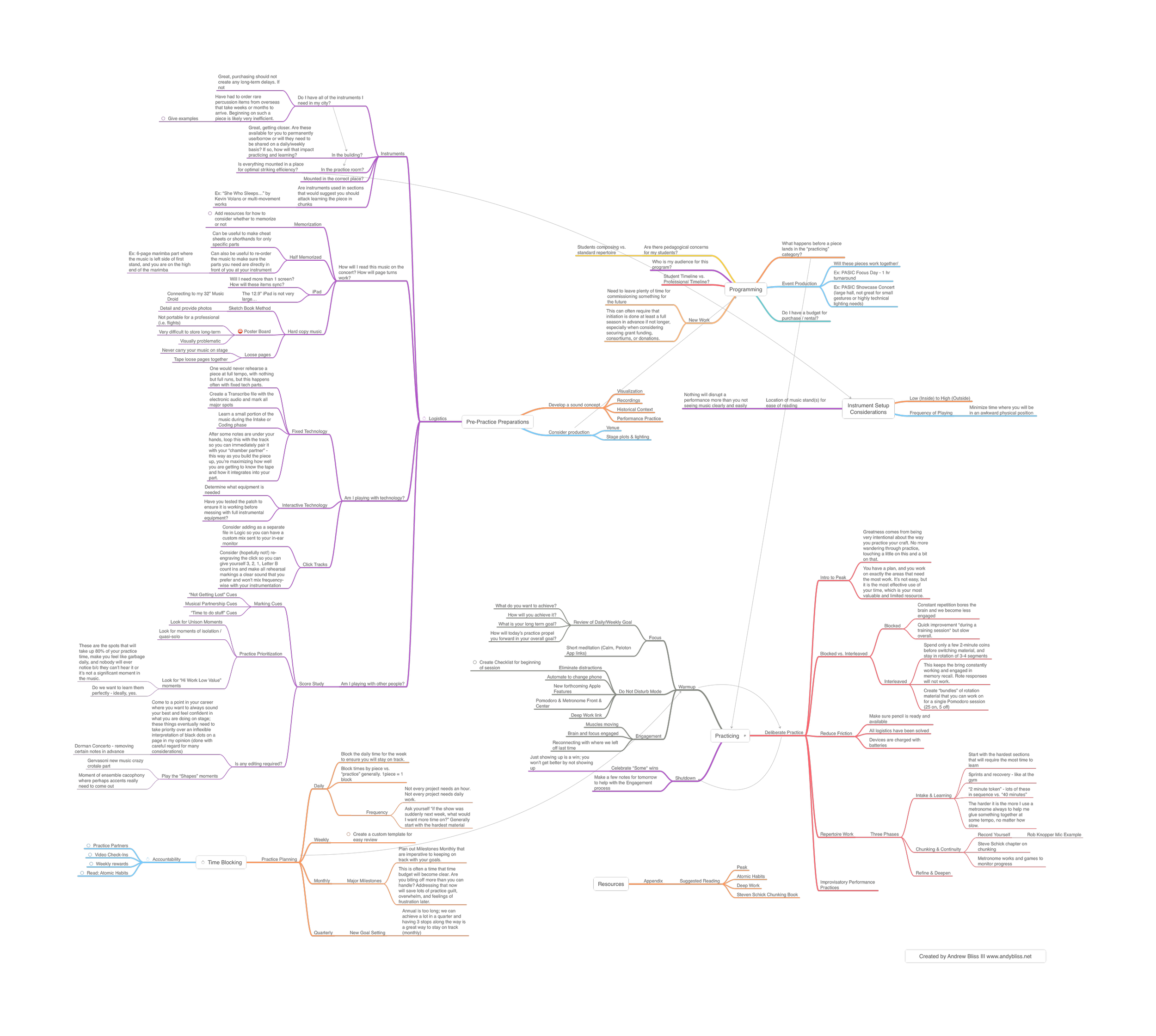
Today I sat down to make a practice log template in Notion for my students, and then this happened…
🤯.
All of my former students know I’m constantly shouting “logistics” from the rooftops. Come on, I know too.
But, this truly surprised me to see how many areas of our forward-facing practice and performance habits trace back to roots tied to preparation and intentionality.
Performance coachings are commonly in service of extracting our best musical selves, but often the friction or gap that is uncovered is several phases back in this process.
We end up skipping so many steps unintentionally. Practicing is very much an iceberg-meme situation; much of the work is underwater and in preparation phases — before we are ever in the room with the instrument.
Fall always represents a return to this methodology for me. My primary goal with my first year university students is to establish practice habits - a healthy balance, great strategies, and supportive, compounding methods for growth.
I hope to share more on this through the month of September (and I really need to get back to that Notion template…) In the meantime, I would love to know:
>> What is on your mind surrounding the topic of practicing?
Drop me a line! 🆎
———
P.S. If you’re curious, this software is called MindNode. It’s absolutely one of my favorite platforms to go when I need to think or pursue some mental untangling!
Batman & Robin
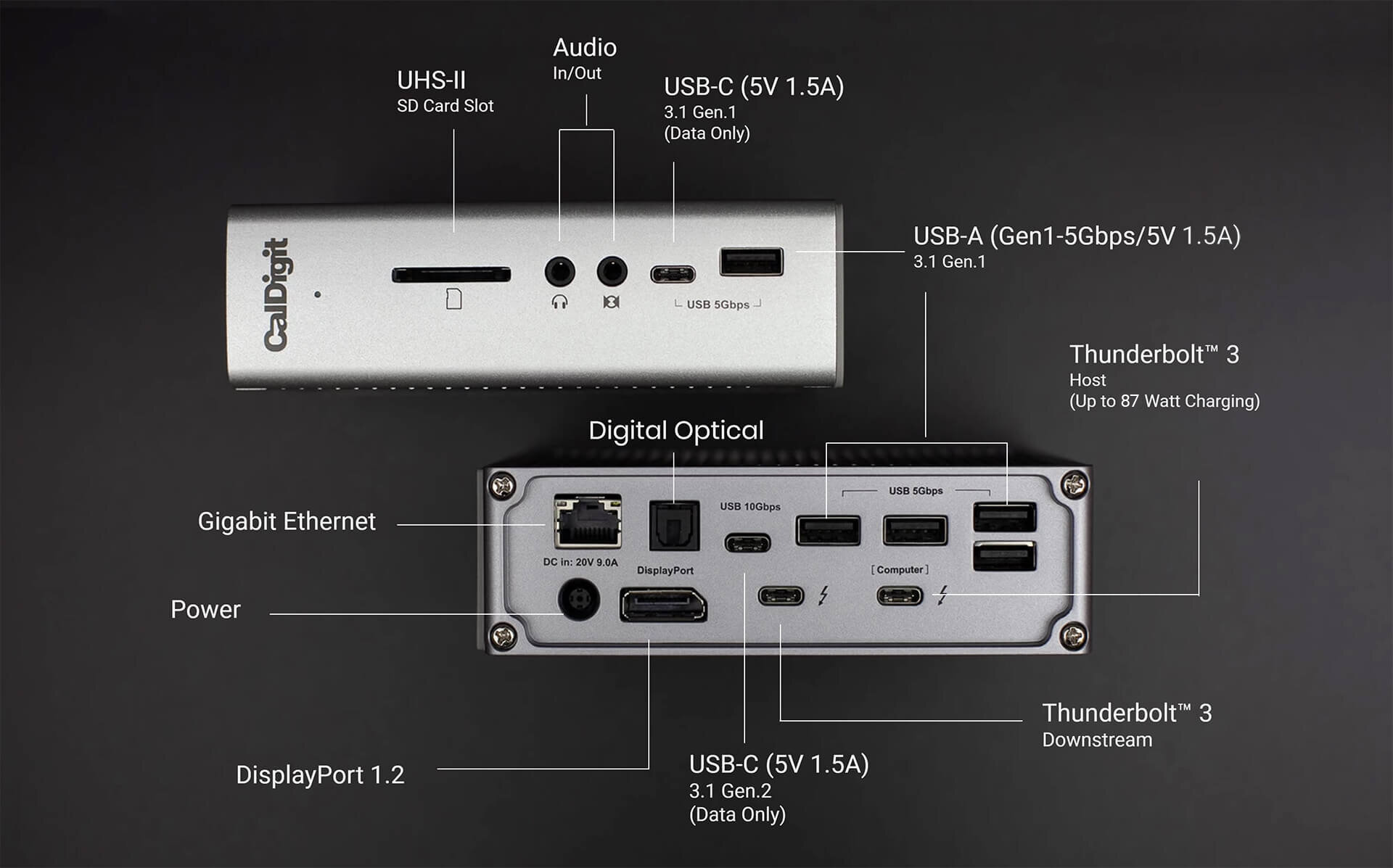
I’m continuing to build out my M1 MacBook Pro workstation, and recently picked up the CalDigit TS3 Plus. I’ve now tried it at two stations and am already loving it. If the MacBook Pro is Batman, this thing is Robin. It’s much, much smaller than I expected, which makes it easy to toss in a bag for a hotel stay or a day trip. In that way, the power cable is a hassle, but much more portable than most peripherals.
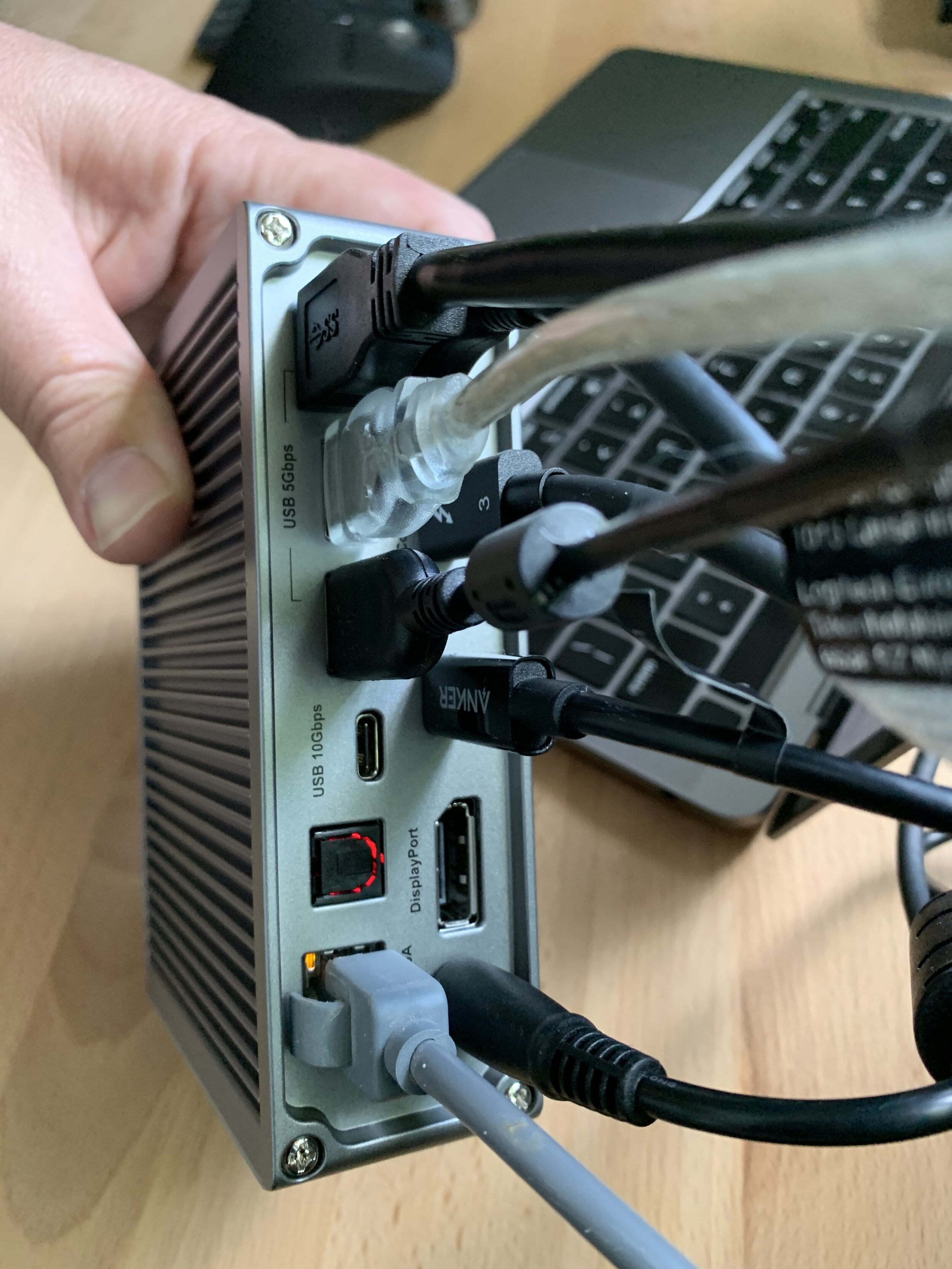
Yesterday I hooked it up via the “Thunderbolt 3” Host port and confirmed it charges my laptop (Holy Smokes!…no power brick needed!), and hooked my external monitor up to the Thunderbolt 3 Downstream port for now (I need to read up a bit on optimum usage of the various USB-C ports vs. Thunderbolt). Then came the USB-A peripheral party: my Canon multifunction printer (which I suppose could go wireless eventually), my ScanSnap ix500, my Logitech webcam, and finally my beloved Focusrite 2i2 to power my monitor speakers. A quick switch of the audio outputs, and BOOM, POW, SHAZAM — no more laptop speaker music. Woohoo!
I also added my ethernet cable and the back was quickly filled up. I was pleased to see that the front audio ports popped up clearly in my system preferences, which will come in handy. I’m also so happy to have an SD card slot at the ready from now on for video editing as I move toward some upcoming YouTube projects.
Some Hops in my Rattle Collection
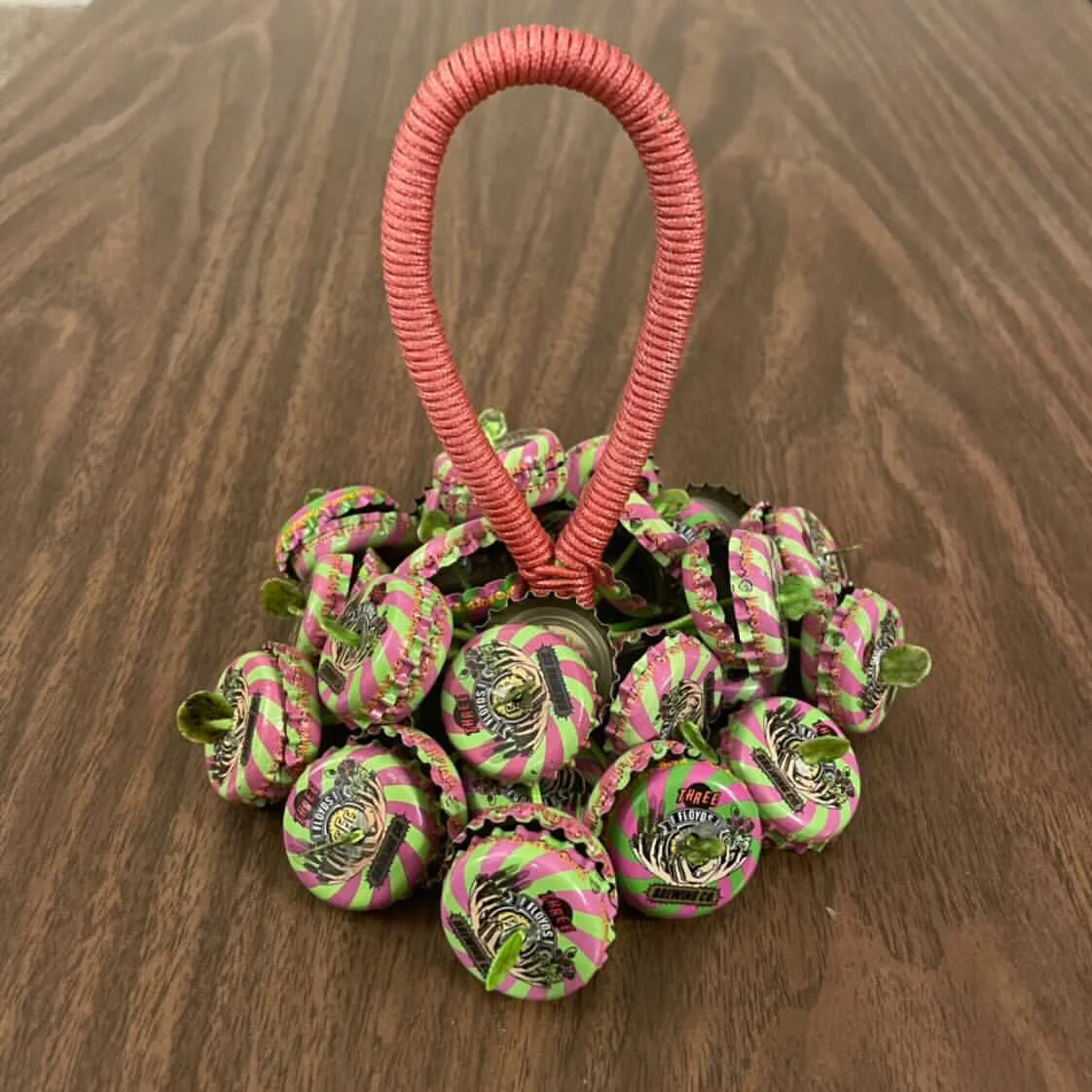
Pretty pumped to add this 3 Floyds Brewing Bottle Cap Rattle to my percussion inventory. Sounds great, extra colorful, and tons of hops!
Thanks to Upcycled Percussion for helping me pick this up. You can check out lots of other cool percussion offerings on their Reverb shop here.
Make Music Knoxville
I was fortunate to direct Elliot Cole’s Flowerpot Music with Nief-Norf & friends for the first ever Make Music Day event in Knoxville. Always such a pleasure to get out and enjoy our local Ijam’s Nature Center here in town and make some music with the local community!
Logitech Reboot
I still remember how excited I was when we bought the Logitech Harmony All-in-One remote back in the mid-90s, which allowed you to program all your devices to one remote control, including your TV, VCR, etc. It was amazing, and little did I know, the beginnings of my interests in home automation.
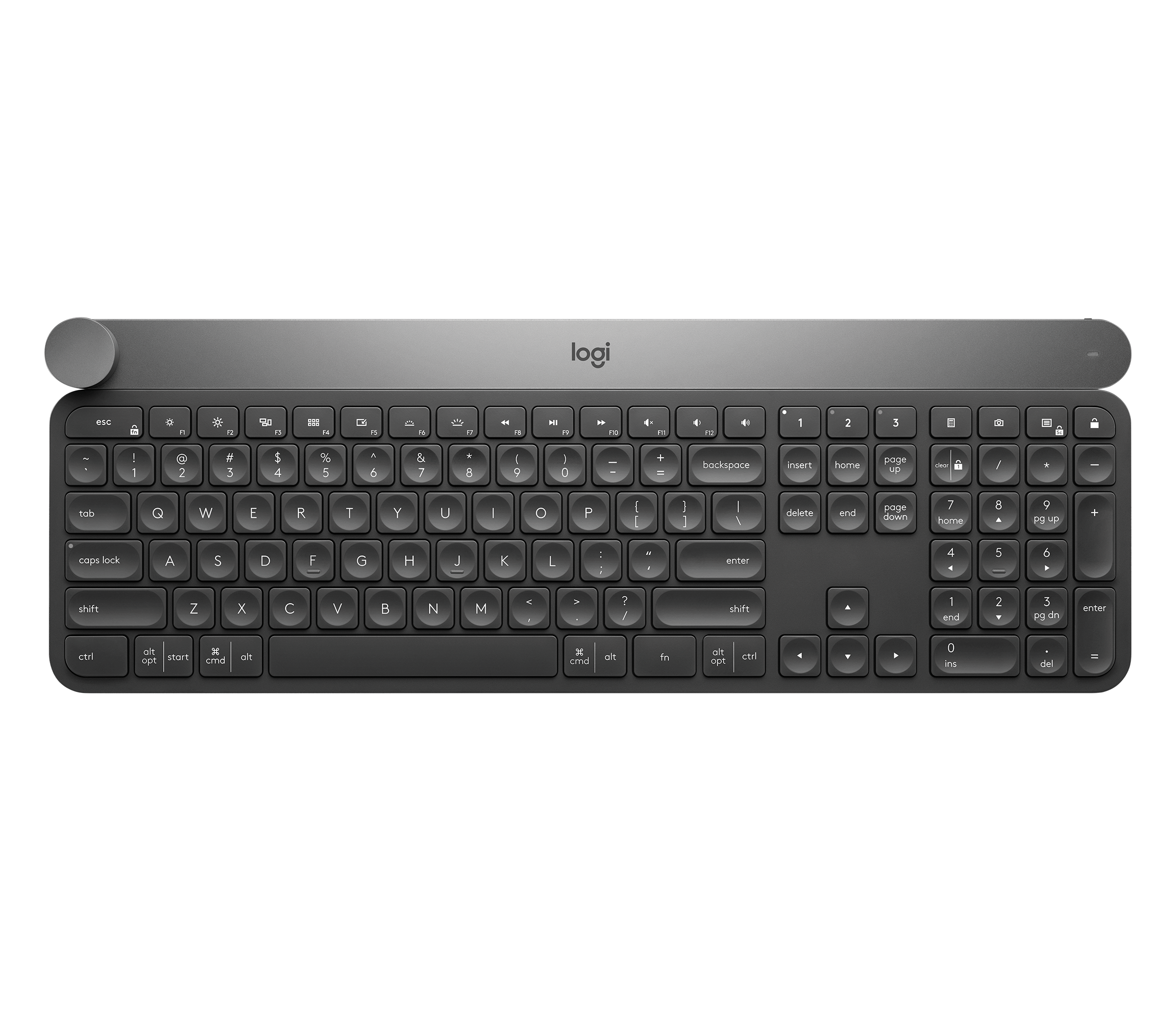
I’ve been using the Apple Magic Mouse for many years now but was recently inspired to check out other options. I picked up the Logitech Craft keyboard and the MX Master 3 for Mac mouse and now I’m in love with them both.
My Apple Magic Keyboard had lost its underside grips and would slide under my hands daily when I typed; having the Logitech Craft now, I can’t believe I waited this long to explore better options. It’s very heavy, I love the way the keys feel when I type (like right now!), and I’ve had no problems pairing it via Bluetooth.
It also hosts some Power User features I didn’t have before, specifically the ability to pair it simultaneously with multiple Bluetooth radios. I have mine set for band 1 to go to my M1 MacBook Pro, band to goes to my 12.9” iPad Pro, and band 3 goes to my iPhone. This makes various tasks throughout the day much faster, and I love being able to work from one station.
I’m also really enjoying the MX Master 3 mouse. The ergonomics are great, I’ve used the left thumb forward/back buttons often, and like that I can easily scroll at two different speeds. I’m still struggling to get used to the bottom thumb button, as I’ve found it to be about an inch behind where my thumb naturally rests.
All in all, very excited to add these two items to my workflow. Moving to a laptop-only lifestyle has been an adjustment, but having these at my workstations has certainly been an upgrade and brought some delight to daily tasks.
The Great Studio Build-Out Begins…
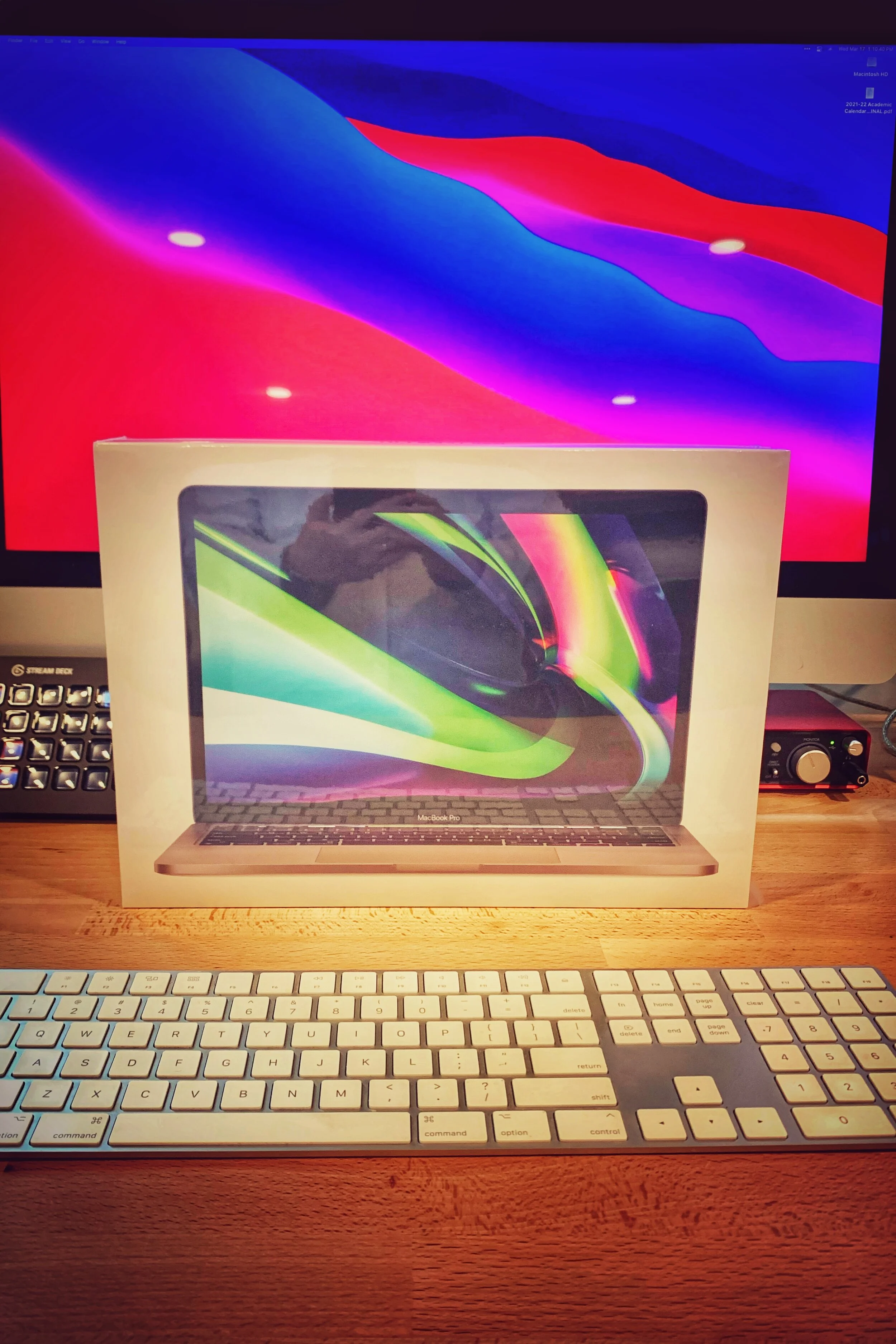
Today is a very exciting day. I’ve been working behind the scenes for months on a new studio upgrade that is inline with a lot of professional goals I have. For those of you who have been around for awhile you likely noticed a face lift on my website recently, which allows me to automate and upgrade my forthcoming newsletter as well as regular scheduling for clients and colleagues.
However, in addition to this, I’ve recently written and received a grant that will be focused on overhauling some of my instruments and significantly bolstering my audio, video, and lighting equipment for content creation. That process begins today with the first item arriving—a 13” M1 MacBook Pro.
I have been an iMac user for 16 years and have had a desktop computer for as long as I remember. My family had an Apple IIe, in high school and college I had a custom built PC, and then when I began grad school I bought an iMac. I love working at a desk and as I’ve proclaimed earlier, am obsessed with large work spaces. I’ve had laptops along the way, but have always had a desktop as my main machine.
However, I’ve always been frustrated by how dialed in I get my home machine, and much of that work doesn’t transfer to my laptop or my desktop at work. At home I have Hazel automating in the background, certain settings in apps like Apple Mail are tweaked, or even something as simple as a new desktop wallpaper may be missing. All kinds of small things occur and I never want to go back and do those a 2nd, or especially, a 3rd time on another machine. In general there is maintenance to multiple machines as well from software updates to battery life, and the friction really adds up.
So, with the announcement of the new Apple Silicon chips, I’ve decided to give the laptop lifestyle a chance. It’s a bit terrifying, but over the coming weeks, I’m planning to (attempt) to merge everything from my home iMac, work iMac, and work laptop (my rock solid 2012 MacBook Air) onto this new 13” M1 MacBook Pro which has been fully upgraded to include 16GB of Ram and a 2TB hard drive. This machine is going to drive audio/video recording sessions as well as all of my daily computing, and I can’t wait to get it fully optimized. Much more to come on this transition and all the equipment coming for the new studio. Until then, it’s a bittersweet day as I step out into new territory with this laptop.
Following Our Artistic Muse
I had a jam-packed, but inspiring, day today which included a business coaching, a collaboration check-in, a faculty task force meeting, applied lessons, and a board meeting. Despite the wide range of these activities I’m often surprised to find through-lines as I shift contexts throughout days like these.
Today’s invisible line surrounded the idea of our artistic muse. My brilliant theory colleague today said (paraphrasing) he has struggled in the past to bring new inspirations to the forefront of his teaching when he viewed his teaching as music theory. However, he recently flipped the equation to be that he teaches logic, equity, and critical thinking (for example) through the medium of music theory. I could not agree with this statement more. As a mentor, teaching percussionists stroke types or rudiments can quickly lead to burnout after decades of this material.
Later today, I attended the Day 3 of 5 of Jennifer Rosenfeld’s business coaching webinar. She had this great line that stuck with me in her discussion:
How do we bring our artistic selves into our business and make space for that, using it as a source of teaching and inspiration for the people that we are serving?
When I heard that I had to check myself to make sure I wasn’t still in the last meeting! I’ve had some success even this semester working with students in real time on topics that are ever-changing and relevant. It’s one of the reasons I’ve moved away from strict curricular structures. I’ve found that some of the best exchanges with students have come from spontaneous learning, often surrounding inspiration from current events, trends, or exposure. Furthermore, I strive to play my instruments as often as possible, because nothing keeps me energized, inspired, and able to relate to the students like a hard practice session earlier in the day.
PAS Board of Advisors
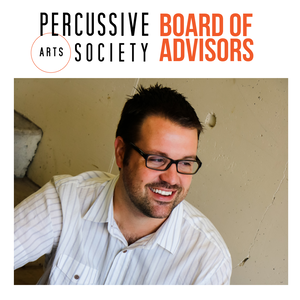
I was honored to learn that I was recently elected to serve a 2nd term on the PAS Board of Advisors. The full announcement is available here.
I’ve been a member of the Percussive Arts Society since 2000 and have thoroughly enjoyed serving this organization in many capacities over the years. I’ve grown a great deal by attending their annual PASIC event each November, and to this day it remains a highlight of my year, seeing friends new and old, and picking up some inspiration to take back to my teaching and performance.
Looking forward to another few years helping out as best as I know how.