Under the Surface
Nobody claps for the outline. But that chaotic layer is exactly what everything beautiful ends up standing on.
My daughter Ellie just turned nine, and right now the two of us are elbow-deep in a new build — not a set from a box, but a MOC (LEGO-speak for “my own creation”): a custom diorama we’re putting together to show at an upcoming LEGO exhibition.
Here’s something most people don’t know about builds like this. We rarely start on a clean baseplate and go straight up. We build a hidden foundation first — a technique called MILS (Modular Integrated Landscaping System): you scatter small bricks across the baseplate in a set pattern, then cap them with a layer of plates. That plate layer becomes your new “ground,” the surface where the real build begins.
And here’s the part I love. The bricks down in that foundation are whatever we can dig up — mismatched colors, odd sizes, leftovers from a hundred old sets. Builders call it “filler brick.” Underneath, it’s a colorful disaster. Total chaos.
But every bit of the beauty — the careful color, the clean lines, the little glowing scenes — starts one plate higher. And none of it would stand for a second without that mess holding it up.
That’s about where I am right now. The beach is behind us, Ellie’s got a new number on the cake, swim season is winding down — and my calendar is quietly filling back in with classes, rehearsals, and a fall that’s coming fast.
For years I resisted this stretch. I’d wish for one more empty week, one more chance to “get caught up.” Now I’ve started to love it, because I finally understand what it actually is.
It’s the filler brick.
This week I’ve been outlining courses my students will step into in a few weeks, interviewing for next year’s studio leadership team, and sitting with a new composition that’s barely starting to find its voice. None of it is finished. A lot of it is messy, whatever-I-can-find groundwork that no one will ever see.
Beginnings rarely get applause. Nobody claps for the outline, the rough first draft, or the calendar you finally untangled. But that chaotic layer is exactly what everything beautiful ends up standing on.
So whatever you’re starting right now, don’t rush past the messy part. It isn’t the boring part, or the throwaway part. It’s the foundation — and the good stuff only rises because of it.
The Beautiful Game
The flashy touches get the applause. The part that actually works lives in the spacing and the timing.
I didn’t grow up with soccer. I’m finding it now, in my forties, and this summer it finally clicked.
Half of it was the company. We chased matches all over Knoxville — Orange Hat Brewing to watch Scotland bow out, the U.S.–Belgium game when we struck out at four different spots before ending up in a friend’s living room with thirty other people, a night at Printshop Beer Co. in South Knox watching Spain beat that same Belgium side. Somewhere in there I stopped being a curious bystander and started loving the game.
Then I watched Spain grind out a 2–0 win over a tough France team. Spain’s second goal looked almost boring on paper — a simple give-and-go, a pass and a run into the space that opened up. No trickery. Just two players who trusted the timing.
I watched it back three times.
They call soccer “the beautiful game,” and I’ve been chewing on why. I think it’s the space.
The most beautiful passing team I’ve ever seen wasn’t even a soccer team — it was the San Antonio Spurs at their peak. That 2014 group moved the ball like it was allergic to standing still: the extra pass, the pass that sets up the pass, five players touching it before an open shot appeared. People called that the beautiful game, too. It was.
I learned this the hard way. Years ago I was the front-ensemble caption head for the Madison Scouts, and my partner-in-crime on the battery was a writer named Roger Carter. Most drumline writing fills in every subdivision — it’s how you keep a dozen drummers locked together. Roger’s didn’t. His was funky, rhythmically irrational, full of space — brutal to clean, and absolutely magnetic to hear. The space was the whole thing.
It’s the same with any groove: the notes you don’t play are what make the ones you do land.
The flashy touches get the applause. But the beautiful part — the part that actually works — lives in the spacing and the timing. The stuff nobody claps for.
So here’s what I’ve been sitting with as summer tips toward a very full fall: where am I forcing the ball? Where am I crowding something that would be more beautiful with a little more space?
Maybe you’re forcing one somewhere too.
Following Our Artistic Muse
I had a jam-packed, but inspiring, day today which included a business coaching, a collaboration check-in, a faculty task force meeting, applied lessons, and a board meeting. Despite the wide range of these activities I’m often surprised to find through-lines as I shift contexts throughout days like these.
Today’s invisible line surrounded the idea of our artistic muse. My brilliant theory colleague today said (paraphrasing) he has struggled in the past to bring new inspirations to the forefront of his teaching when he viewed his teaching as music theory. However, he recently flipped the equation to be that he teaches logic, equity, and critical thinking (for example) through the medium of music theory. I could not agree with this statement more. As a mentor, teaching percussionists stroke types or rudiments can quickly lead to burnout after decades of this material.
Later today, I attended the Day 3 of 5 of Jennifer Rosenfeld’s business coaching webinar. She had this great line that stuck with me in her discussion:
How do we bring our artistic selves into our business and make space for that, using it as a source of teaching and inspiration for the people that we are serving?
When I heard that I had to check myself to make sure I wasn’t still in the last meeting! I’ve had some success even this semester working with students in real time on topics that are ever-changing and relevant. It’s one of the reasons I’ve moved away from strict curricular structures. I’ve found that some of the best exchanges with students have come from spontaneous learning, often surrounding inspiration from current events, trends, or exposure. Furthermore, I strive to play my instruments as often as possible, because nothing keeps me energized, inspired, and able to relate to the students like a hard practice session earlier in the day.
Stepping Off the Merry-Go-Round
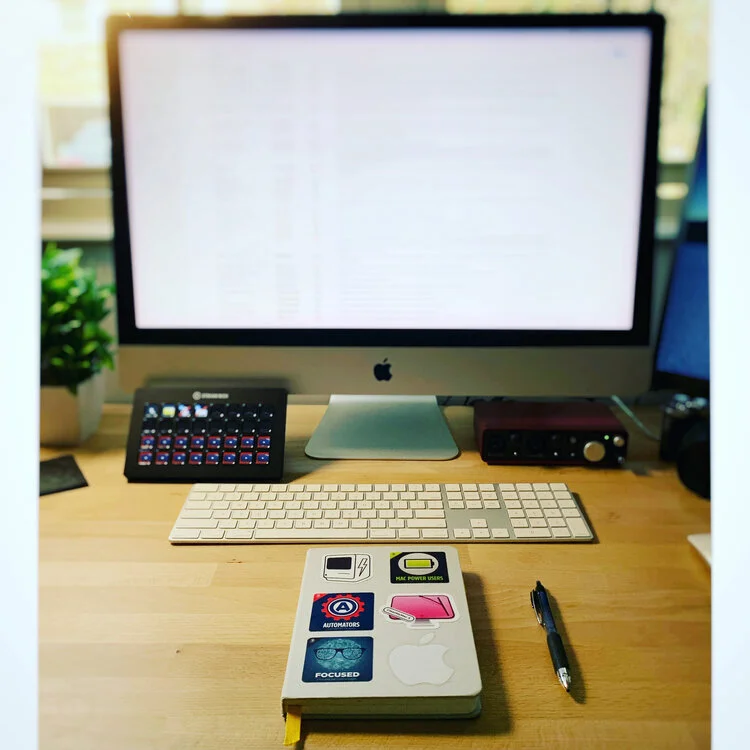
I’ve had an enjoyable afternoon looking at the last 24 months of my professional activity and asking myself the 3 big review questions:
What should I start doing?
What should I keep doing?
What should I stop doing?
Prompted by a session Jennifer Rosenfeld is giving online this week, it felt great to carve out the time to stop producing, and just reflect. A mentor of mine always used to call this getting off the merry-go-round, and he was a master at planning and implementation. I have a regular weekly/monthly/quarterly review process and these questions come up regularly, but specifically this time I got out my calendar and clicked through each week, reflecting on the pros and cons of some of my past decisions.
I opened up a page in my Baron Fig Confidant Notebook, and after doing some work, eventually transferred a more polished version into Notion. I now have this document for easy review, any time I want to add to it down the road or review while making a decision.
I encourage you to give this exercise a try. And if you do, shoot me a note and let me know how it went. It’s widely known that saying “No” can be difficult, but cleaning up the map of our past can make the road forward a little less hazy.
Friday Inspiration Boost
It’s an immediate inspiration-Dynamax (yes, I’m down with the Pokémon) when my two favorite drummers drop new tracks on the same day. I had to think about that statement for a moment, but in the last year I’d be hard-pressed to name two drummers whose playing I’ve enjoyed more than these two gentlemen.

Dafnis Prieto released his latest album Transparency today on his independent label with his Sextet. His most recent album Back to the Sunset has been on loop in my car for almost a year now after hearing him live with Michel Camilo in November 2019 at PASIC. That concert was transcendent for me; I don’t remember being that moved by live music since hearing Stevie Wonder here in Knoxville back in 2015. Both of these concerts along with a small handful of others are moments I will never forget in my life. I’m listening to Transparency now as I wrap up my week at my desk, with the cool October breeze coming in through the window, and it’s setting all the right vibes. Dafnis is one-of-a-kind.

As if that’s not enough of a gift, this afternoon Larnell Lewis released his latest track Change Your Mind on YouTube, from his forthcoming album Relive the Moment. I found Larnell through his work with Snarky Puppy and of course through his viral video on YouTube, where he walks through the process of learning a song in one listen. I’ve got November 20th marked on my calendar for the release of the full album over on Bandcamp. Bob Reynolds’ latest video teased some upcoming behind-the-scenes footage of Larnell in a Snarky Puppy session last week, which I’m also looking forward to checking out.
Top all of this off with the EA Release of Star Wars: Squadrons (affiliate link) hitting shelves today for PS4, and I’m pretty sure I am all set heading into the weekend. If you need me tomorrow, you’ll find me in Studio AB, gunning down TIE fighters with some sick background tracks.
On a New Artistic Practice
I’ve been using my time this summer to begin building a new creative output, centered on composition and improvisation, and largely using the drumset and various technologies as the medium. Breaking away from decades of work that has largely revolved around performing through interpretation, this has been a refreshing endeavor and a journey that promises to challenge me.
I’ve been inspired for several years by Ed Sarath’s writings on the performer-composer-improviser model of training university music students, and have applied this widely throughout my teaching and mentoring. It is refreshing to have my own work catch up to that of my teachings, but has also posed a number of thought-provoking questions:
What Does a Productive Practice Session Look Like When I am Improvising?
I spend many hours each week teaching students how to apply deliberate practice, break down learning into chunks, and to appreciate a slow and methodical method of engraining material the first time. As interpreters we work on setting attainable goals so every session feels like a “win.” It’s clear that with this shift in artistic practice, I’m going to have to re-learn how to create efficiently and re-define what it means to have a good day.
How Much Constraint is Needed to Effectively Compose?
I’ve known for quite some time that the best artistic product often comes from various constraint systems. However, one of the drumset’s most appealing elements is its orchestrational possibilities. This dichotomy immediately poses creative dissonance. Bags of mallets and non-traditional implements, cymbal stacks and effects, drum sizes and tuning, and setup configurations all create a limitless amount of combinations that is both extremely exciting and paralyzing all at once. I’ve already found that it can be difficult to find a way in.
Where is the Line Between Breadth and Depth When Using New Technologies?
I’ve been exploring a few pieces of software and hardware that were the original inspiration for this journey, but these systems pose similar constraint issues. I’m working hard to avoid shiny-object syndrome and each new piece of technology feels like learning a new instrument from scratch. So much potential and I want to make sure I’m respecting the range of each thing I consider adding to the arsenal of sounds.
Will I be Able to Recognize my own Voice Among These Sound Sources?
Additionally, many DAW setups can produce some incredible varieties of beats natively. At my core, I’ve always been drawn to rhythm, and there’s nothing to say that many of these will not be appealing. After all, very few creatives are only drawn to a singular style or medium. I’ve depended on my curatorial ear and instinct thus far as an artist, however the combination of these mediums has roots in genres I have far less background in. I believe it is going to take some time for me to find a mode of creation that feels authentic, and exposure and listening to new-to-me artists is going to be an important (and equally refreshing) part of that journey.
Facing these questions at the beginning of this journey is daunting to say the least. It can make it difficult to begin most days. But I am energized by the idea of creating my own body of work, of developing my own meta-instrument, and of weaving in and out of many genres that inspire my soul. It remains to be seen if this journey will more closely resemble Taylor Swift pivoting from country music or Michael Jordan playing for the White Sox. Either way, I am doing my best to embrace these challenges and as always, enjoy the process.
Rainy Day Baseball
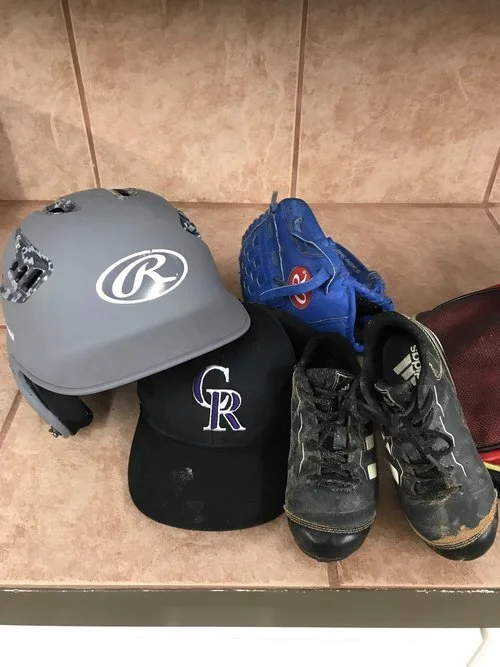
Spent a good amount of weeknights away from work this Spring at my son's first season of baseball, playing for the Rocky Hill Rockies. Just stumbled upon this pile of his well-used gear in my office today, the remnants of the sky opening up last night in the 2nd inning of his final game. It's been a real joy teaching him to play and hanging with his team this year.
No End in Sight
The editor's note, by Matt McCue (@MattMcCueWriter) in this quarter's edition of 99U Magazine focused on an interview with architect Peter Marino and grabbed my attention. In a past interview, McCue discussed how Marino spoke about generating ideas:
When he first started out, he said it took him all week to come up with an idea, but now he thinks up 10 a day, easily. They just come to him. Impossible, I thought. It took all my effort to squeeze out a half-baked idea once every seven days.
However, years later I'm realizing there is truth to Marino's statement. Once you've pushed your brain to come up with hundreds of ideas, you do something to your mind. You unknowingly switch it to the "always on" mode and you can't help but observe everyday life through your creative lens...In the process the barrier between work and play disintegrates, because work becomes play.
McCue then refers to multiple creatives in their prime who are 65 years old and still pushing ahead with their creative endeavors, and I see the same in the music world.
It was a pleasant reminder that having more ideas to tackle than one can ever pursue in a lifetime is a privilege, and should not be a point of stress or pressure. I'm fortunate to live in a world with no punch-clock.
Home Game: An Accidental Guide to Fatherhood by Michael Lewis

In a recent appearance on the Tim Ferriss show, Malcolm Gladwell made a mention of the story-telling prowess of Michael Lewis. He considered himself an amateur compared to Lewis, and I made particular note of this. I've read nearly all of Gladwell's books and enjoyed them thoroughly. In addition, Moneyball might be one of my all-time favorite reads, likely due to its fusion of baseball, mathematics, and the story-telling that Gladwell references.
I picked up a few of Lewis' books recently and, while at the beach on vacation, knocked out Home Game in a couple of evenings. It had me laughing out loud regularly and it was a great get-away read. With a baby on the way in September, it was a timely choice.