PAS Board of Advisors
I was honored to learn that I was recently elected to serve a 2nd term on the PAS Board of Advisors. The full announcement is available here.
I’ve been a member of the Percussive Arts Society since 2000 and have thoroughly enjoyed serving this organization in many capacities over the years. I’ve grown a great deal by attending their annual PASIC event each November, and to this day it remains a highlight of my year, seeing friends new and old, and picking up some inspiration to take back to my teaching and performance.
Looking forward to another few years helping out as best as I know how.
Peer Learning
A favorite podcast of mine is The Tim Ferriss Show, and I particularly enjoyed Episode #168, his interview with Malcolm Gladwell. In the course of the interview, Ferriss asks Gladwell "What is an example of some of the worst advice that you hear being dispensed, or given?"
The beginning of his answer included "I think the American college system needs to be blown up and we need to start over." Okay - you have my attention.
Gladwell shares:
"The sole test of what a good college is, is, is it a place where I find myself late at night, having deeply interesting conversations with people that I like and find interesting...Am I so inspired by what I learned during the day that I want to be talking about it at one in the morning, and do I have someone who will have that conversation with me and will challenge me? That's it, everything else is nonsense."
Gladwell goes on to discuss the importance of students not being interesting, but interested, and the value of asking good questions. I've thought about Gladwell's response multiple times over the last year and often struggle with how to respond when I am frequently asked about how a half-dozen schools stack up, and where a student should consider attending. I came across this wonderful quotation this week that helped to further articulate this point that Gladwell raised:
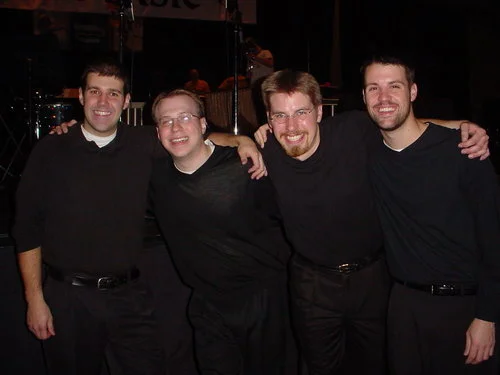
Base4 following our PASIC 2003 Showcase Concert
It often happens that two schoolboys can solve difficulties in their work for one another better than the master can. When you took the problem to a master, as we all remember, he was very likely to explain what you understood already, to add a great deal of information which you didn’t want, and say nothing at all about the thing that was puzzling you. I have watched this from both sides of the net; for when, as a teacher myself, I have tried to answer questions brought me by pupils, I have sometimes, after a minute, seen that expression settle down on their faces that assured me that they were suffering exactly the same frustration which I had suffered from my teachers. The fellow-pupil can help more than the master because he knows less. The difficulty we want him to explain is one he has recently met. The expert met it so long ago he has forgotten. He sees the whole subject, by now, in a different light that he cannot conceive what is really troubling the pupil; he sees a dozen other difficulties which ought to be troubling him but aren’t.
– C. S. Lewis, “Introductory” to Reflections on the Psalms
One reason I offer group classes at the freshman and sophomore level at UT, in addition to one-on-one applied study, is this transfer of knowledge that can happen among peers. I often think back to my time at Northern Illinois University and can't begin to articulate how much I learned from Pat Schleker, John Pobojewski, and Steve Lundin while playing together in the Base4 Percussion Quartet – rehearsing together on our own [crazy] ambition for ~6-8 hours a week over 3 years, outside of class, working through dozens of musical puzzles together that shaped the way I work now.
Curriculum Diversity
After a busy summer, I was able to take some time this weekend to enjoy reading Anne Lanzilotti's insightful series on Building Curriculum Diversity, published by New Music Box this past July.
The most lucid moment in my reading was in Part Three of the series, where Lanzilotti shares a portion of an interview with violinist Jennifer Koh:
It is our responsibility as artists to advocate for artists and composers who happen to be women or people of color. I feel that we as artists and as an industry need to model and advocate for our entire community. And frankly, diversifying programming is the only way that classical music will survive. If our programming does not reflect the diversity of our society, then we are not serving our community and by extension, we are actively making ourselves irrelevant to society.
With classes starting at many institutions around the country these past few weeks, this is an especially good time to consider the diversity issues raised in these thoughtful essays. As many of us are preparing the storyline by which we will pass down the history of music to our current students, the resources offered would be immediately useful for anyone compiling musical examples. At a deeper level, the three essays also helped me to articulate things I already believed more clearly, gave me plenty of new artists to investigate, and left me with several sources that I would like to read and learn more from.
10 Reasons to Let Students Major in Music
I really enjoyed this Forbes article by Liz Ryan on the advantages high school students gain when majoring in music. Choosing a university and a degree program can be very tricky for parents and students, and often my meetings with high school visitors at the University of Tennessee surround some of the questions that are addressed.
In addition to Ryan's compelling list of reasons supporting a degree in music, I would also add two additional points (at least):
11. My music students become very good at managing their time and multiple responsibilities. With performances, exams, and other personal deadlines, the students learn how to keep all of the plates spinning and how to deliver in public arenas while doing so.
12. Music students also learn to work with a wide variety of colleagues in close, collaborative environments, something we see in the professional world daily. Some of these colleagues are friends, and some...are not. Part of being a professional is learning how to work and communicate with a wide variety of individuals.
I found this article to summarize many of the important advocacy points for high school students who might be feeling pulled to a life in the arts after high school.
New Music Gathering Keynote Remarks: Steven Schick
For those of us who were not able to attend the recent New Music Gathering event at Bowling Green State University, we are fortune to have the opening remarks by Keynote Speaker Steven Schick available, who spoke about the theme of support. The full transcript can be found here on my new favorite website, The Log Journal, the journal of NY's National Sawdust, edited by Steve Smith.